
Kenya’s pharmaceutical sector is one of the fastest-growing industries in East Africa. With a population exceeding 55 million, rising chronic disease burden, a growing middle class demanding better healthcare, and government initiatives to expand Universal Health Coverage (UHC), the demand for locally manufactured medicines has never been higher.
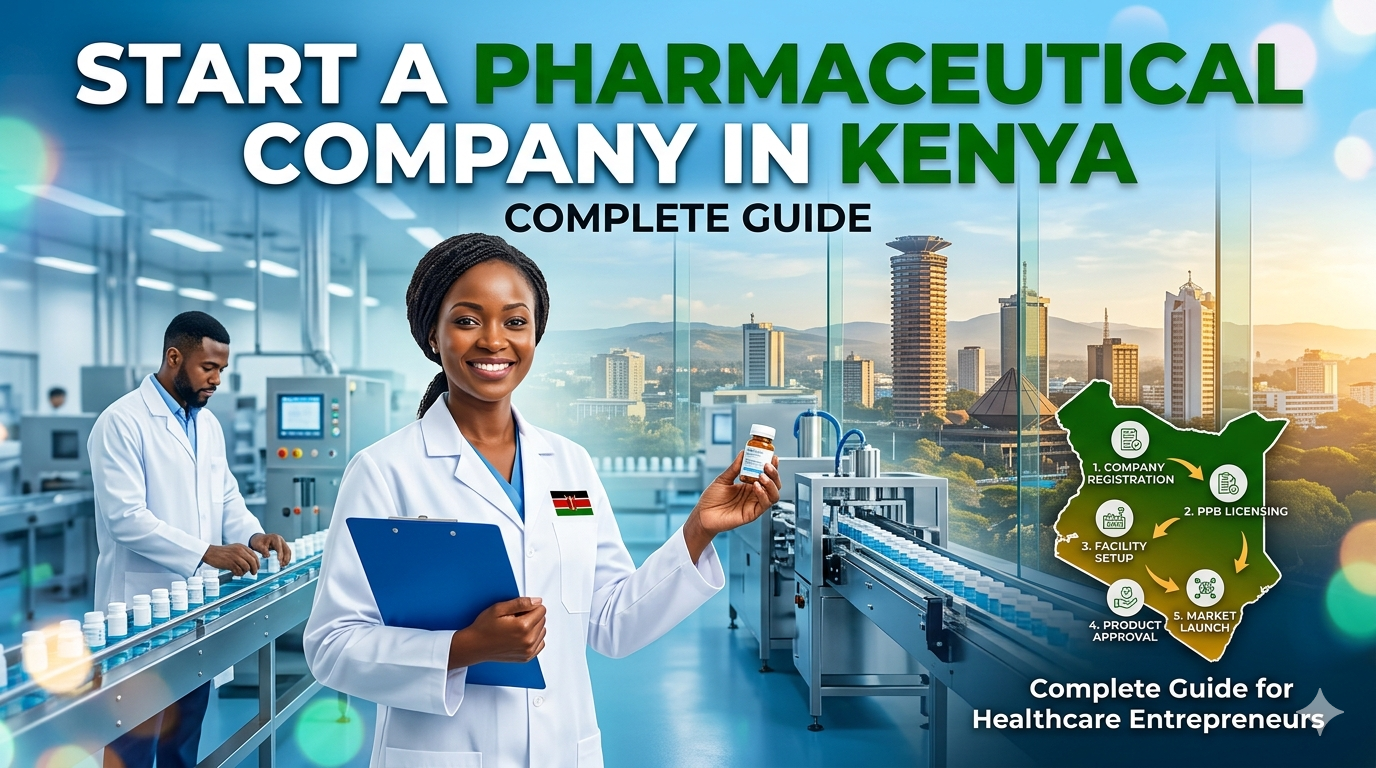
Yet most of that demand is still being filled by imports. According to the Kenya National Pharmaceutical Policy, the country imports over 70% of its medicines. That gap is not a warning — it is a business opportunity hiding in plain sight.
If you have been thinking about starting a pharmaceutical company in Kenya, this guide will walk you through every critical step — from concept to your first product on a pharmacy shelf.
Why the Kenyan Pharmaceutical Market Is Ready for New Players
The Kenyan government’s Buy Kenya Build Kenya initiative, combined with the African Continental Free Trade Area (AfCFTA) opening East African markets to local manufacturers, has created a favorable regulatory and economic environment for new pharmaceutical entrants.
Local manufacturing means shorter supply chains, faster response to disease outbreaks, and medicines priced for African purchasing power. For a new entrepreneur, this translates to real competitive advantages over foreign importers — if you know how to navigate the system correctly.
Step 1: Define Your Niche and Conduct Market Research
Before anything else, you need to know which segment of the pharmaceutical market you are entering. Kenya’s pharmaceutical landscape covers several distinct verticals:
- Generic medicine manufacturing — producing off-patent molecules at affordable prices
- Nutritional supplements and nutraceuticals — vitamins, minerals, and wellness products
- Herbal and traditional medicine — an underserved area gaining regulatory recognition
- Contract manufacturing (CDMO) — manufacturing for other brands under GMP conditions
- Medical devices and diagnostics — regulated separately but adjacent to pharma
Research questions to answer before proceeding:
- What therapeutic area has the greatest unmet demand in your target region?
- Which medicines are currently being imported that could be produced locally at a competitive cost?
- Who are the existing manufacturers, and what is their capacity gap?
- What price point will government hospitals, NGOs, and private pharmacies actually pay?
Talk to hospital procurement officers, community pharmacists, and county health administrators. Their purchasing pain points will tell you more than any market report.
Step 2: Register Your Business with the Relevant Authorities
A pharmaceutical business in Kenya requires multiple layers of legal registration before a single tablet can be manufactured or sold.
Company registration (Business Registration Service): Register your company under the Companies Act 2015 with the Business Registration Service (BRS). Choose a company name that is unique, professional, and reflective of your healthcare focus. Most founders underestimate how much the company name matters — it affects investor perception, hospital procurement trust, and long-term brand equity.
During this stage, using an AI-powered name generator can help you generate pharmaceutical brand names that sound credible, are easy to pronounce across languages, and have logo-friendly visual identity. The name you choose now will be on every product label, every regulatory submission, and every partnership proposal for years to come.
Before committing, verify that your chosen name does not conflict with existing businesses. Kenya’s pharmaceutical sector is relationship-driven — a name too similar to an established player creates confusion and potential legal exposure. Tools that analyze similar business names can save you from an embarrassing or costly rebranding down the line.
Other registrations required:
- Kenya Revenue Authority (KRA) — PIN certificate and VAT registration
- NSSF and NHIF employer registration
- County government business permit for your facility location
Step 3: Navigate PPB Registration — The Most Critical Step
The Pharmacy and Poisons Board (PPB) is Kenya’s regulatory body for pharmaceuticals. Every product you manufacture, import, or distribute must be registered with the PPB before it can enter the market.
Facility registration: Before product registration, your manufacturing facility must be inspected and certified by the PPB for Good Manufacturing Practice (GMP) compliance. This involves:
- Site master file preparation
- Building and equipment validation documentation
- Standard Operating Procedures (SOPs) for every process
- Quality management system documentation
- Staff qualification records
GMP certification is not a one-time event. It requires ongoing compliance, scheduled audits, and a culture of documentation that must be embedded in your operations from day one.
Product registration (dossier submission): Once your facility is certified, each product requires its own dossier submitted to the PPB containing:
- Pharmaceutical development data (formulation rationale)
- Manufacturing process and controls
- Quality control specifications and analytical methods
- Stability data — typically 6 months accelerated + ongoing real-time data
- Bioequivalence or clinical data (for certain categories)
- Labeling and artwork drafts
PPB review timelines vary from 6 months for priority medicines to 24+ months for standard submissions. Plan your cash flow accordingly.
Pro tip: Engage a regulatory affairs consultant early. PPB dossier preparation is technical, and a rejection due to incomplete data can significantly reset your timeline.
Step 4: Secure Funding and Build Your Facility
Pharmaceutical manufacturing requires substantial capital investment. A basic GMP-compliant small-scale facility in Kenya typically requires KES 20–50 million at minimum, scaling to hundreds of millions for multi-product operations.
Funding sources to explore:
- Kenya Industrial Estates (KIE) — government financing for SME manufacturers
- Development Finance Institutions — PROPARCO, IFC, and East African Development Bank have active healthcare portfolio mandates
- Angel investors and healthcare VCs — increasingly active in African health infrastructure
- Pharmaceutical partnerships — contract manufacturing arrangements where a larger brand funds your facility setup in exchange for production capacity
Consider starting with a contract manufacturing model (CDMO) to generate revenue and build operational expertise before launching your own branded products.
Step 5: Build Your Online Presence Before Your First Product Ships
Many pharmaceutical startups in Kenya build their physical facility but neglect their digital presence until after launch — this is a significant strategic error.
Hospital procurement officers, NGO supply chain teams, and county government health officials now conduct supplier due diligence online before initiating any contact. If your company does not have a professional website, you will not make it past their initial screening.
Your pharmaceutical website should include:
- Clear product catalogue with technical specifications
- GMP and PPB certification details are prominently displayed
- Company background, founder credentials, and quality philosophy
- Contact forms for procurement inquiries
When launching your website, ensure search engines can discover and index it from day one. Generating a proper XML sitemap and submitting it to Google Search Console is a technical step many pharma startups skip — and then wonder why no one finds them online. A sitemap generator tool makes this process straightforward, even if you do not have a dedicated web developer.
One thing to note: as your inquiry form starts receiving traffic, you will inevitably get contact form submissions from disposable or fake email addresses — researchers testing your form, bots, or competitors checking your response time. Filtering these early protects your sales team’s time and keeps your lead database clean.
Step 6: Build Your Distribution Network
Kenya’s pharmaceutical distribution network is dominated by large distributors in Nairobi (Mombasa Road corridor), with secondary networks in Kisumu, Mombasa, and Nakuru.
As a new manufacturer, your distribution strategy should prioritize:
- Direct supply to county hospitals — county governments procure through Kenya Medical Supplies Authority (KEMSA) and direct tenders. Building relationships with county health directors is essential.
- Independent pharmacy chains — mid-sized pharmacy groups (10–50 outlets) are more willing to trial new manufacturers than large chains, and they pay faster than government institutions.
- NGO and faith-based health networks — organizations like AMREF, Family Health International, and mission hospitals procure large volumes of essential medicines and actively seek locally manufactured alternatives.
- Comet Healthcare partnerships — established local manufacturers with existing distribution infrastructure sometimes offer co-distribution arrangements for complementary products.
Step 7: Invest in Pharmacovigilance from the Start
Many new pharmaceutical companies treat pharmacovigilance (post-market safety monitoring) as a regulatory checkbox. In reality, it is one of your strongest competitive differentiators.
Documenting adverse event reports, managing market complaints professionally, and responding proactively to any quality signals builds the kind of trust with healthcare professionals that no marketing budget can buy. Kenya’s healthcare community is small and interconnected — one poorly handled product complaint spreads fast; one exemplary quality response spreads faster.
The Opportunity Is Real — But So Is the Work
Starting a pharmaceutical company in Kenya is not a quick path to revenue. Regulatory timelines are long, capital requirements are significant, and quality standards are uncompromising. But for entrepreneurs willing to invest in doing it right, the market opportunity — backed by Kenya’s growing population, government healthcare expansion, and AfCFTA access to 54 African markets — is genuinely transformational.
The companies that will define Kenya’s pharmaceutical landscape over the next two decades are being built right now. The question is whether you will be one of them.